IP blocking is one of the fastest controls available to an administrator. A source scans a server, attempts repeated logins, or sends hostile requests; the firewall receives a new rule; the traffic disappears. The immediate result is real, but it can create a dangerous conclusion: if blocking worked once, a longer list must provide stronger security.
That conclusion confuses a tactical response with a security architecture. Modern attackers can use VPN services, residential proxies, cloud servers, mobile networks, Tor exit nodes, compromised computers, botnets, and short-lived virtual machines. When one address is denied, another can appear within seconds. A distributed attack may never generate enough activity from any single address to cross a local threshold.
The objective is not to make IP blocking disappear. The objective is to place it in the correct layer: useful for known, current, and sufficiently confident indicators, but never responsible for defending the complete service.
An IP Address Is Not an Identity
An IP address identifies a network endpoint at a moment in time. It does not prove who is operating it, whether the device is trustworthy, or whether the same person will use that address again. Many legitimate users can also share one public address through carrier-grade NAT, corporate proxies, mobile networks, or shared cloud infrastructure.
That ambiguity produces two kinds of error. A block may remove access from legitimate customers who happen to share infrastructure with an abusive source. At the same time, the person responsible for the abuse may continue through a new endpoint. The organization accepts operational impact without meaningfully changing the attacker’s capability.
Addresses remain valuable context. They can indicate reputation, geography, hosting provider, autonomous system, recurrence, or association with known malicious infrastructure. They become more useful when combined with account, session, device, endpoint, token, behavioral, and historical signals. They become dangerous when treated as identity or authentication.
Four Security Myths
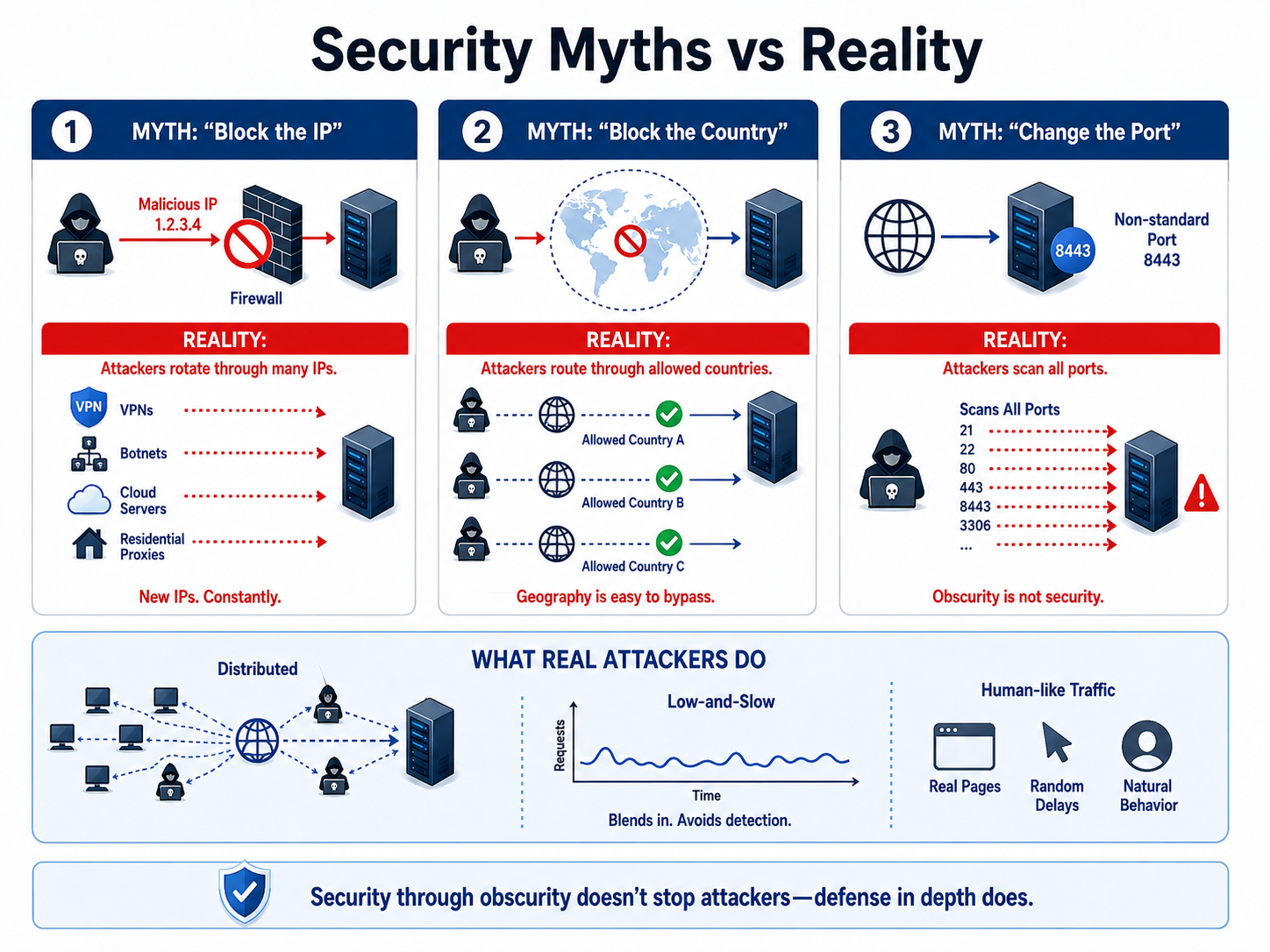
Myth 1: Blocking the IP protects the system
Blocking a confirmed source can stop that source temporarily. It does not stop an attacker who rotates through VPNs, cloud instances, residential proxies, compromised machines, or an IPv6 address range. The block is a response to one observed path, not to the actor or technique behind it.
Myth 2: Blocking the country protects the system
Geolocation describes the approximate registration or routing location of an address. It does not establish the physical location or identity of the person sending the traffic. An attacker in a blocked country can route through a permitted country, and a serious attacker may intentionally use infrastructure close to the target so the connection appears ordinary.
Geographic controls can still be useful when they reflect a real business boundary. If an application serves only a defined region, blocking or challenging unexpected locations may reduce noise. The control should be treated as secondary filtering and risk context, not as a security boundary.
Myth 3: Blocking the busiest sources stops the attack
Request thresholds work against basic scanners, malfunctioning clients, and concentrated abuse. They are much less effective against distributed and patient attackers. Instead of sending 100,000 requests from one machine, an attacker can send one request from each of 100,000 devices. Each source appears quiet while the aggregate activity remains significant.
Low-and-slow techniques spread login attempts, endpoint discovery, long-lived connections, and password spraying across hours or days. Effective rate limiting therefore needs context: account, session, API token, endpoint, organization, device, authentication state, behavioral risk, and total system load.
Myth 4: Changing the port hides the service
Moving RDP from 3389, SQL Server from 1433, or HTTPS from 443 can reduce noise from the most primitive scanners. It does not provide meaningful protection. Modern tools scan every available port and identify services from protocol responses, TLS negotiation, certificates, banners, timing, error messages, and application-specific behavior.
Changing a port is obscurity. Actual protection comes from reducing exposure, patching, segmentation, encryption, strong authentication, authorization, and monitoring.
The Recommended First Layer: A Managed Reverse Proxy
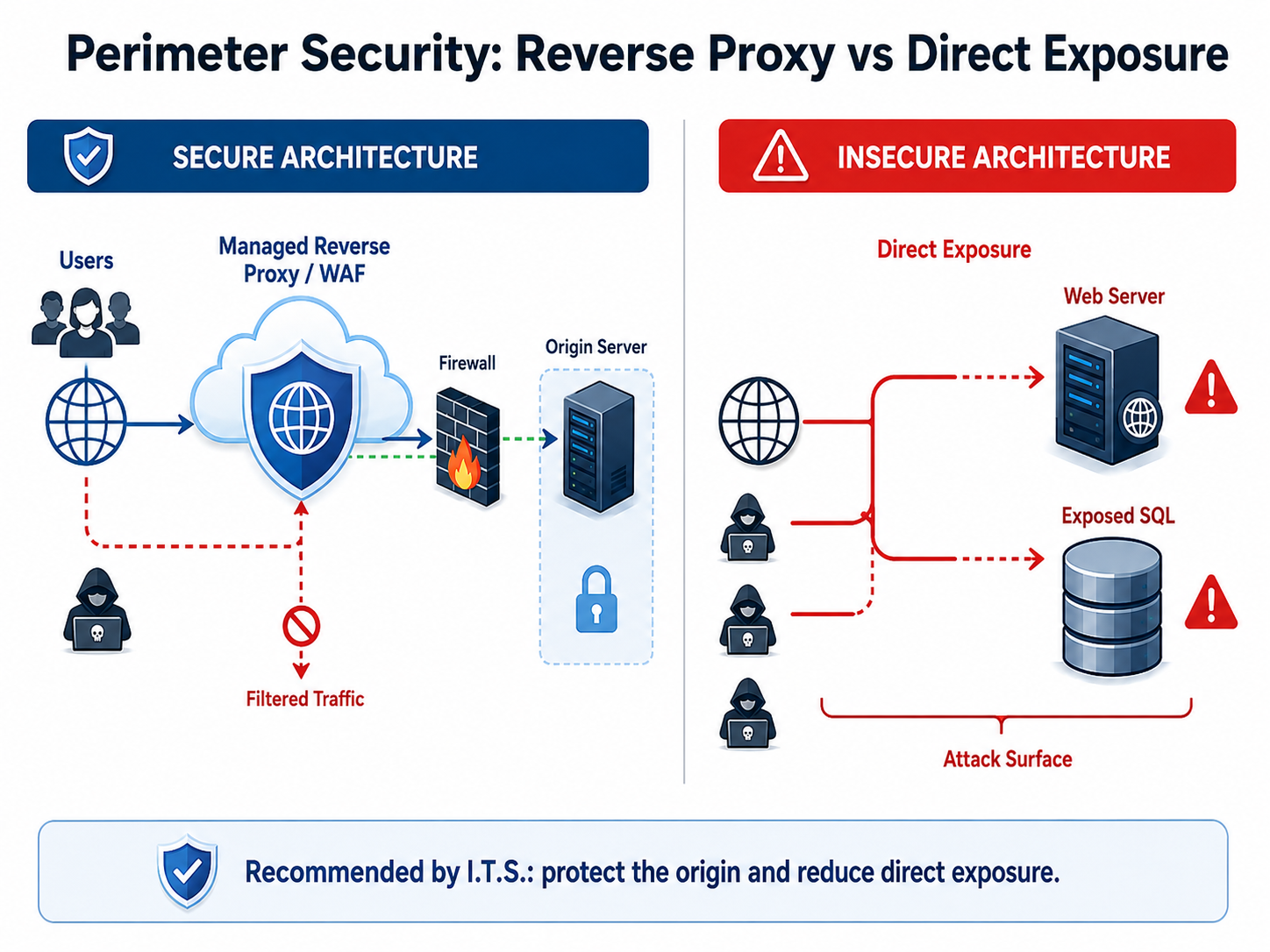
Most organizations should place public applications behind a managed reverse proxy, content-delivery network with security controls, or equivalent edge service. Users connect to the intermediary platform rather than directly to the server that hosts the application. The platform can inspect, filter, challenge, limit, cache, or reject requests before they consume the organization’s bandwidth and origin resources.
Depending on the provider and configuration, the edge layer may provide:
- Distributed denial-of-service protection.
- A Web Application Firewall (WAF).
- Rate limiting by several request characteristics.
- Bot detection and challenge mechanisms.
- IP, geographic, network, and reputation filtering.
- TLS termination and certificate management.
- Caching and origin-load reduction.
- Centralized traffic analytics and rapid emergency rules.
A specialized provider observes traffic across many systems and can absorb volumes that would overwhelm a small organization’s firewall, Internet circuit, or local server. For an organization without a mature security operations team, this is usually safer and more economical than attempting to reproduce the same capacity internally.
The proxy does not eliminate the need to secure the operating system, application, database, secrets, authentication, or code. It reduces direct exposure and gives the organization another independent control point.
The Origin Must Be Protected
Enabling proxying in DNS while leaving the origin publicly reachable from every source creates a bypass. If an attacker discovers the real origin address through historical DNS, certificate records, an application response, email infrastructure, or another leak, the attacker can send traffic directly to the server and avoid the edge controls.
The origin firewall should accept web traffic only from the reverse-proxy provider, a private tunnel, or another authenticated path. Administrative access should use a separate private management route. The organization should test periodically that no alternate hostname, address, port, or load-balancer listener exposes the origin.
Systems That Should Not Be Directly Exposed
Database servers
SQL Server and other database engines should not be generally reachable from the public Internet for application or administrative access. Moving the listener to another port does not make the database private. Connectivity should be restricted through private networks, VPNs, authenticated tunnels, strict allowlists, private endpoints, application-layer access, and segmented management networks.
The normal public path ends at the application layer. The database belongs behind it, with access limited to the systems and operators that require it.
Administrative interfaces
RDP, firewall portals, hypervisor consoles, backup systems, storage administration, deployment services, internal monitoring, and device management should normally remain private. When remote administration is necessary, use a private access layer with multifactor authentication, device validation, network segmentation, and least-privilege authorization.
Unprotected origin web servers
IIS, Apache, and NGINX are designed to serve web traffic. The risk is not the existence of a public web server; it is publishing an origin without sufficient controls. At minimum, an Internet-facing origin needs current security updates, hardened configuration, strong TLS, a WAF, contextual rate limiting, centralized logging, continuous monitoring, application isolation, restricted HTTP methods, protected administrative routes, secure secret management, vulnerability scanning, and an incident-response procedure.
Detection Controls That Add Real Signal
IDS and IPS
An Intrusion Detection System observes traffic or events for suspicious behavior. An Intrusion Prevention System can also block or interrupt selected activity. These controls can identify port scanning, repeated authentication attempts, known exploit patterns, malware communication, command-and-control traffic, unusual protocol behavior, lateral movement, and unexpected outbound connections.
An IDS does not make a vulnerable system secure. Its primary value is visibility and early detection. The signal becomes stronger when IDS and IPS events are correlated with firewall, application, authentication, endpoint, WAF, cloud, database-audit, and honeypot data.
Honeypots and deception
A honeypot is a system, service, account, file, or resource designed to attract unauthorized activity. Legitimate users and processes should have no reason to touch it, so almost every interaction is suspicious. A honeypot can simulate an SSH server, SQL instance, administrative portal, file share, legacy API, privileged account, or document containing fake credentials.
The advantage is signal quality. In production traffic, the line between unusual and malicious can be difficult to draw. A well-designed honeypot can reveal reconnaissance, scanning tools, attacker commands, payloads, lateral movement, and indicators of compromise with few false positives.
The honeypot must be isolated. It should contain no real data, reusable credentials, or unrestricted route to production. It is a detection mechanism, not a replacement for patching, authentication, segmentation, or application security.
Threat Intelligence and Dynamic Blocklists
Manual IP blocking is insufficient, but malicious-address intelligence is still useful. Security vendors, research organizations, and industry groups maintain changing feeds of IP addresses, networks, domains, URLs, and other indicators associated with botnets, malware, scanning, spam, or command-and-control infrastructure.
These feeds should not be understood as permanent lists of bad addresses. An address may be listed because a compromised system generated hostile traffic, then later be cleaned, reassigned, or removed. Useful reputation data therefore includes the source, detection date, confidence, threat category, last observed activity, supporting evidence, and expiration.
Reputation feeds are effective against known malicious infrastructure. They are not reliable against a newly created cloud server, a previously unseen address, a recently compromised legitimate host, a residential proxy, a trusted user acting maliciously, or a zero-day exploit arriving from a clean source. Reputation is an additional layer, not the decision maker for the whole perimeter.
Firewall Automation and an Internal Reputation Service
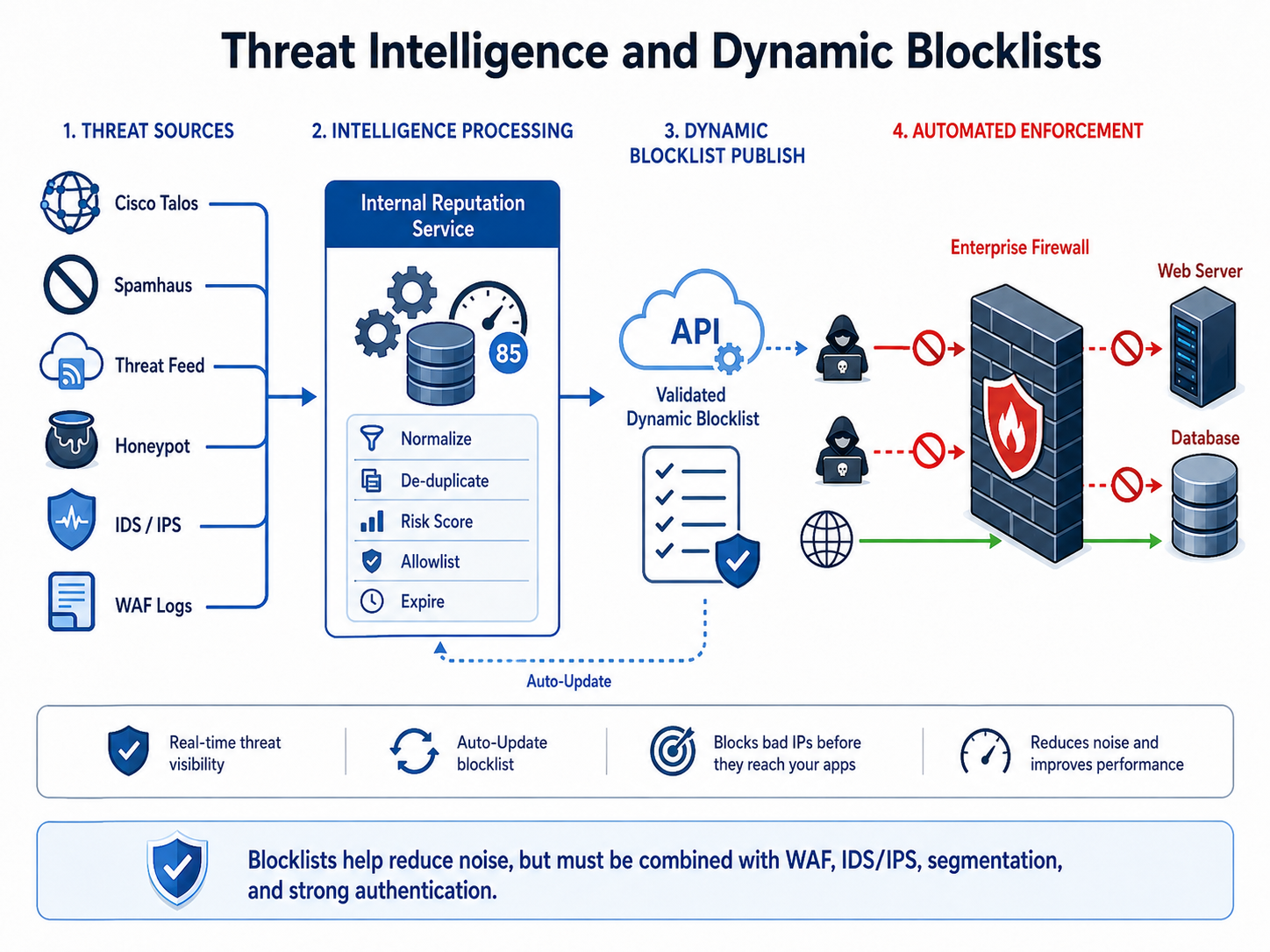
Enterprise firewalls commonly support external threat feeds, dynamic lists, connectors, or automation APIs. An organization with software-development capability can build a small internal service that combines external intelligence with its own WAF, IDS/IPS, EDR, authentication, honeypot, and incident data.
A defensible workflow looks like this:
trusted external feeds + internal detections
        → validate and normalize IPv4, IPv6, and CIDR data
        → remove duplicates and exclude trusted services
        → assign confidence, risk, reason, and expiration
        → publish a versioned HTTPS feed
        → firewall retrieves and enforces the current list
        → expired indicators are removed automatically
The firewall does not need thousands of manually maintained objects. It consumes a validated list whose lifecycle is managed elsewhere. External dynamic lists are often preferable to continuous configuration changes because they reduce commits, simplify rollback, and separate threat-intelligence operations from firewall-policy design.
Direct API changes are better reserved for urgent, time-limited incident response. Every automated action should retain the source, reason, score, duration, related event or ticket, and complete audit trail.
A custom reputation service should use HTTPS, authentication, source validation, integrity checks, IPv4 and IPv6 validation, duplicate removal, maximum-entry limits, allowlists, expiration logic, health monitoring, versioning, last-known-good data, rollback, audit history, and manual override. No external provider should be able to modify firewall policy directly without an internal validation boundary.
The Risks and Limits of Automated Blocking
Automation can scale an error as quickly as it scales a correct decision. False positives, stale intelligence, reassigned addresses, shared proxies, mobile carriers, VPN services, public-cloud ranges, compromised feeds, excessive object growth, and performance degradation can all create operational failures.
A single high-confidence address observed exploiting a honeypot may be reasonable to block automatically. Blocking an entire cloud-provider range because one address behaved badly may disconnect customers, partners, APIs, and internal services. The potential impact should influence both the evidence threshold and the scope of enforcement.
Safer implementations use several trusted sources, confidence scoring, expiration, allowlists, testing before enforcement, maximum list sizes, source attribution, reason codes, review of high-impact ranges, monitoring for false positives, and fast rollback. Actions can also vary by risk:
low risk       → log and monitor
medium risk    → rate-limit or require additional verification
high risk      → block temporarily
critical risk  → block immediately and alert the security team
A Stronger Defense-in-Depth Architecture
The common weakness in IP, country, port, and request-count blocking is that each depends on an attribute the attacker can change. A mature perimeter combines independent controls so bypassing one layer does not create unrestricted access.
- Reduce exposure. Publish only services that are genuinely required.
- Use a managed reverse proxy or WAF. Inspect and filter traffic before it reaches the origin.
- Protect the origin. Reject direct connections that bypass the approved edge path.
- Segment the environment. Separate public services, applications, databases, management, and backups.
- Strengthen identity. Use multifactor authentication, certificates, tokens, conditional access, and device validation where appropriate.
- Authorize every sensitive action. Do not treat the initial login as permanent trust.
- Rate-limit with context. Consider account, device, session, endpoint, token, behavior, and aggregate load.
- Combine intelligence with detection. Correlate WAF, IDS/IPS, EDR, application, identity, cloud, database, and honeypot events.
- Automate proportionally. Log, challenge, restrict, block, or isolate according to evidence and impact.
- Test the perimeter. Verify that controls work and that no alternate route exposes the origin or management plane.
There is no single firewall rule that solves Internet security. The architecture succeeds when prevention, detection, response, and recovery remain useful even after one control is evaded.
Final Principle
Blocking addresses, countries, ports, or high-volume sources can reduce noise and stop unsophisticated activity. These controls become dangerous only when their visible activity is mistaken for complete protection.
The correct question is not how many addresses were blocked. It is whether an attacker can reach the service, exploit a weakness, move through the environment, and remain undetected.
Reduce exposure, protect the origin, validate identity, watch behavior, and make every automated block one accountable layer in a larger defense.