Software engineering is often described as if it were a mechanical process: define everything at the beginning, assign enough people, write the code, test at the end, and deliver a finished product. That model is attractive because it promises certainty. It is also the source of many recurring project mistakes.
Real software projects combine technology, people, data, operating procedures, business decisions, and incomplete information. The system must work inside an organization that continues changing while the project is underway. Good engineering therefore depends not on eliminating uncertainty, but on exposing it early and managing it deliberately.
The following myths are not arguments against planning, accountability, quality, or architecture. They are warnings against treating useful practices as absolute rules outside the conditions that make them effective.
Myth 1: Adding More People Makes the Project Finish Faster
Additional people do not produce a proportional increase in delivery speed. Every new contributor must learn the business, understand the architecture, configure a working environment, absorb team conventions, and discover which assumptions are not written down.
As the team grows, so does the coordination surface. There are more communication channels, reviews, dependencies, merge points, and decisions. Experienced contributors redirect part of their time from implementation to onboarding and supervision.
more people
    → more onboarding
    → more coordination
    → more interruptions for experienced contributors
    → a temporary reduction in delivery capacity
Adding people can help when the work is clearly divisible, the architecture supports parallel development, and the team has the capacity to integrate new contributors. Adding them late to tightly coupled work can slow the project further before any additional capacity appears.
Myth 2: The Client Knows Exactly What They Want—or Does Not Know What They Want
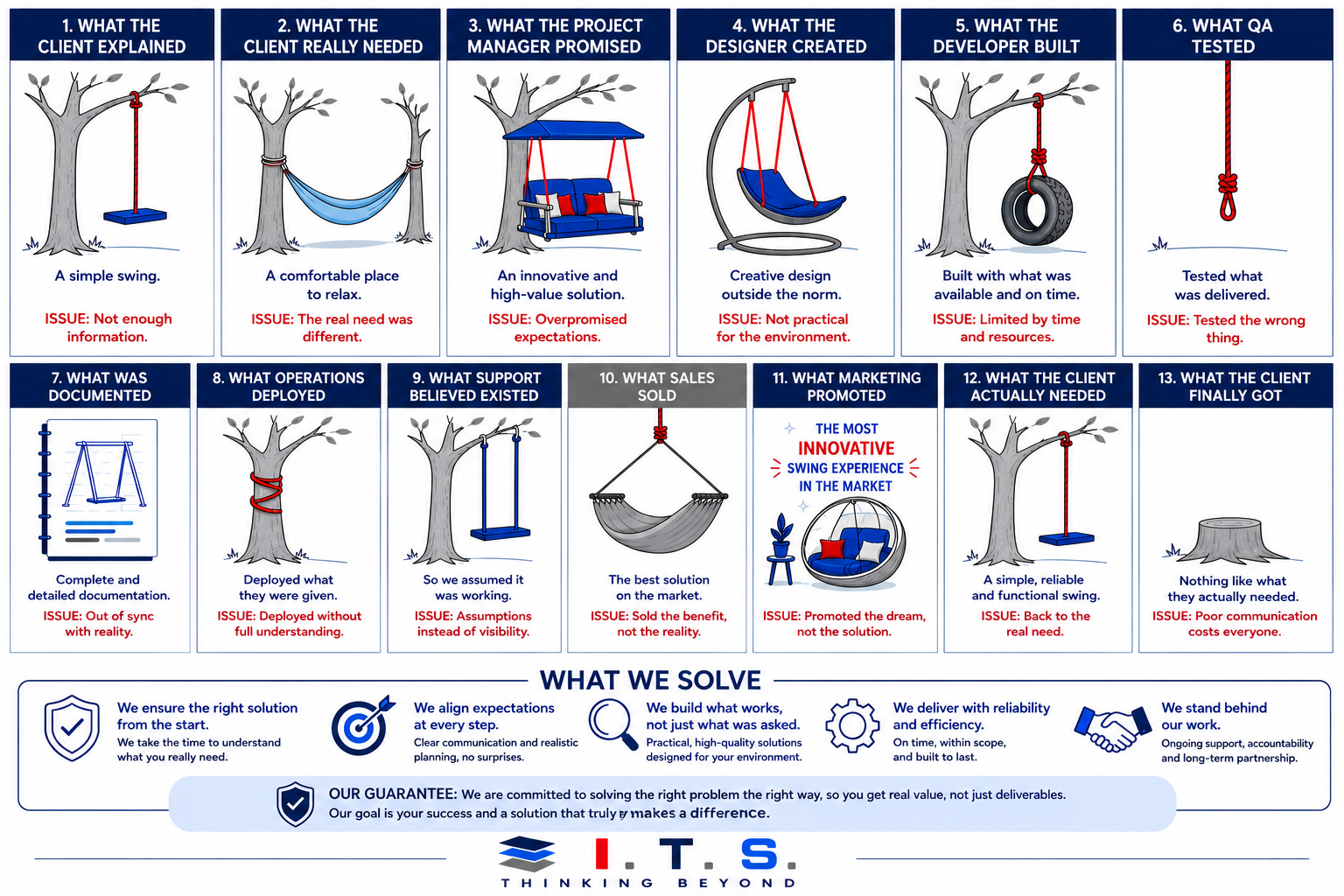
Both statements are oversimplifications. The client usually understands the problem, operational constraints, recurring exceptions, and the outcome the organization needs. The client may not know how to convert that knowledge into technical requirements, data models, interfaces, or processing rules.
A client may also request a particular solution because it is the only available vocabulary for describing the need. A request for another report may actually represent a need for an alert, an operational control, or a process change.
The technical team should not implement every request literally, but it should not assume that the client is ignorant of the business. The solution emerges through observation, focused questions, prototypes, data analysis, and continuous validation.
The client primarily knows the problem*. The technical team primarily knows the available ways to solve it.
* Sometimes the client does not yet know the actual problem, only its visible symptom. A client may request a report of overdue claims because supervisors discover delays too late. However, the missing report may not be the root cause. The claims work queue may have no clearly assigned owner because users were not properly trained or the system was implemented without assigning responsibility to a specific user or role. The queue may also use a date range that excludes the oldest claims or a default sort order that hides them. Building the requested report would expose the symptom while leaving the operational failure unchanged. Discovery must determine whether the request describes the actual problem, a symptom of another problem, or only the client's proposed solution.
Myth 3: The Client Is Always Right—or the Developer Always Knows the Best Solution
Neither side possesses all the information required to make the best decision alone. The client understands priorities, economic impact, regulatory obligations, and operational reality. The developer understands technical constraints, maintenance risks, security, performance, and architectural consequences.
A client can request something unnecessarily expensive. A developer can propose an elegant design that does not solve the real problem or is too complicated for its users. Authority, seniority, and technical sophistication do not make a decision correct.
The defensible solution sits at the intersection of business value, technical feasibility, usability, cost, security, and operational capacity. Evidence, prototypes, measurements, and risk analysis should resolve disagreement whenever possible.
business knowledge
        +
technical knowledge
        +
evidence from real use
        =
a defensible product decision
Myth 4: Enough Meetings Will Produce a Complete, Unchanging Specification
Meetings clarify requirements, but they do not eliminate uncertainty. Users generally describe normal processes well, yet may omit rare exceptions, implicit rules, or knowledge they apply without consciously articulating it. Some scenarios remain invisible until a realistic test exposes them.
Seeing the first working version also changes what stakeholders can understand. This does not necessarily mean that the client changed direction arbitrarily. It often means the project has produced information that did not exist when the original document was written.
A specification should be precise enough to direct work, versioned so decisions remain traceable, and designed to evolve under change control. Concrete examples, acceptance criteria, prototypes, and early testing usually reveal more than another sequence of abstract meetings.
Myth 5: The Software Is the Project, and Operations Can Work Independently from Technology
Software is only one part of an implementation. The project may also require changes to data, processes, responsibilities, controls, training, policies, support, measurements, and contingency procedures.
A technically correct application can fail when the source data is unreliable, users do not understand the new operating model, or the organization continues working in a way that conflicts with the design. Separating the work into “technology owns the software” and “operations owns the business” creates two different projects.
A classic version of this mistake begins when the COO tells the CIO: “You focus on the system; I will take care of operations.” The statement sounds like a clear division of responsibility. In practice, it can separate two parts of the same design. Operations continues changing procedures, responsibilities, priorities, exceptions, spreadsheets, and performance measures, while the technical team builds workflows, work queues, permissions, validations, and reports around the original operating model. Both groups feel they are making progress, but they are moving in different directions—creating inefficiency, rework, and a system that no longer matches the operation*.
* Separate ownership does not mean independent design. Operations and technology must continuously validate one shared operating model.
successful implementation =
    software
    + reliable data
    + aligned processes
    + trained people
    + controls
    + support
    + operational ownership
Technology and operations must share one operating model. The rules enforced by the system must match the rules applied by people. Success is not the delivery of an application; it is the consistent operation of the complete process.
Myth 6: Technology Solves the Business Problem, and Automation Removes the Need to Understand It
Technology can enable a solution, but it cannot replace understanding. Automating a poor process may only execute its errors with greater speed, volume, and consistency. Ambiguous rules, unclear ownership, and unreliable data do not disappear when code is introduced.
Before automating, the team must understand which decision is being made, what information it requires, which source is authoritative, who owns exceptions, and which controls must exist.
Automation can reduce manual work, improve visibility, and prevent specific errors. It cannot replace governance, responsibility, or business knowledge. A process usually must be understood more precisely to automate it than it ever was when performed manually.
Myth 7: Software Is Eventually Finished—or It Will Never Be Finished If We Keep Listening to Users
These are equally misleading extremes. A version, feature, or project phase can finish when it satisfies defined acceptance criteria. The system will nevertheless remain exposed to changes in the business, regulations, security, infrastructure, integrations, and user expectations.
Listening to users does not mean implementing every request. Product management must determine which changes create value, which should wait, and which should be rejected. Some requests identify genuine operational needs; others reflect personal preferences or attempts to preserve a process that should be retired.
Software can be complete for an agreed scope and release without being permanently complete. The required discipline is an explicit boundary for the current commitment and an equally explicit strategy for maintenance and evolution.
Myth 8: Estimates Are Exact Commitments Rather Than Predictions
An estimate is a prediction based on available information, stated assumptions, and a level of uncertainty. Undocumented business rules, external dependencies, poor data, technical limitations, and regulatory changes can all alter the work. The less the team knows, the wider the responsible estimate should be.
Turning every estimate into an exact promise creates damaging incentives. Teams inflate numbers, hide risk, reduce testing, or remove necessary work to protect an arbitrary date.
Estimates should identify assumptions, dependencies, ranges, and confidence. They should be updated when the evidence changes. A project may commit to a date, a cost, or a scope, but fixing all three simultaneously usually transfers the remaining uncertainty into quality, risk, or unplanned work.
Myth 9: Users Are Resistant to Change
Users do not always reject change. They often reject a change that increases their workload, reduces their control, introduces risk, or fails to solve the problem. Resistance can also appear when users do not understand the objective, were excluded from design, received insufficient training, or must operate the old and new processes at the same time.
A slower workflow or confusing interface does not become a good solution merely because it is new. Resistance should therefore be treated as information. It may reveal a design flaw, a missing requirement, an incentive problem, or an operational risk the project did not consider.
Adoption improves when users participate early, understand why the change is necessary, can test realistic scenarios, and experience a concrete improvement in their work.
Myth 10: More Features Mean Better Software
Every feature has a cost that continues after development. It must be documented, tested, secured, monitored, supported, and maintained. It also adds complexity to the interface, code, database, and integrations.
A rarely used capability can consume more resources than the value it creates. The best software is not the product that does the most things. It is the product that solves the important problems correctly with the least reasonable complexity.
Before adding a feature, evaluate its business value, frequency of use, operational effect, security exposure, and lifetime cost. Removing or simplifying a feature can improve a product more than adding another one.
Myth 11: Every Release Must Be Perfect
Perfection is neither objective nor attainable. There will always be improbable scenarios, possible improvements, and defects with negligible impact. Waiting for perfection can create oversized releases, long periods without feedback, and a more dangerous deployment because too many changes arrive together.
A release should be secure, stable, usable, observable, and appropriate for its intended purpose. Critical defects must be resolved, but not every defect has the same severity, probability, or operational consequence.
Gradual deployment, feature flags, monitoring, rollback procedures, and rapid correction make controlled release possible. This is not permission to ship carelessly. It is a measurable quality policy that distinguishes unacceptable risk from work that can responsibly follow in a later release.
Myth 12: Testing and Performance Optimization Can Wait Until the End
Testing is not an isolated phase that begins after programming. It should accompany analysis, design, and implementation. When testing is postponed, misunderstood requirements, architectural flaws, and integration problems are discovered at the point where they are most expensive to correct. The planned test window is also the first schedule item sacrificed when development takes longer than expected.
Performance requires the same distinction between responsible planning and premature optimization. The team does not need to optimize every line of code in advance, but it cannot ignore structural questions such as data volume, concurrency, latency, query design, network boundaries, and communication between components.
A poor architecture cannot always be repaired through final tuning. Test strategy, performance targets, and representative load scenarios should be defined early and validated throughout development.
Myth 13: Bugs Are Exclusively the Developer's Responsibility
A defect can originate in code, but it can also begin with ambiguous requirements, contradictory rules, incorrect data, configuration, an external integration, confusing design, or an unreliable deployment process.
Developers are responsible for the quality of their implementation. System quality, however, is shared by analysts, product owners, users, testers, architects, developers, and operations. Decisions made by any of these participants can prevent or introduce defects.
Automatically blaming the developer can hide the real cause and allow the failure to repeat. The useful question is not only who introduced the defect, but why the delivery system failed to prevent or detect it earlier.
Which control, information, test, or validation was missing?
Myth 14: Functional Requirements Are Sufficient
A system can perform every documented function and still be unusable in its operating environment. In addition to describing what the system must do, the project must define security, privacy, performance, availability, recovery, auditability, accessibility, compatibility, maintainability, and observability.
A system may calculate the correct result while taking several minutes, losing the history of who changed a record, or failing to recover after an interruption. It might be functionally correct and operationally unacceptable.
Nonfunctional requirements should be measurable. “The system must be fast” cannot be verified. “Under the defined production load, 95 percent of requests must respond within two seconds” can be tested, monitored, and governed.
Myth 15: We Can Design Today for Every Future Scenario
Trying to anticipate every future requirement usually creates an architecture that is excessively complicated for problems that do not yet exist. Abstractions built without evidence can become constraints. The team spends time creating extension mechanisms that may never be used while making current work harder to understand and maintain.
This does not mean ignoring the future. It means designing for known requirements, identifying where change is reasonably likely, and preserving clear paths for evolution and migration.
A good architecture does not predict every future scenario. It lowers the cost of adapting when the future becomes concrete. The objective is software prepared to change, not software based on the illusion that today's team can know every need of tomorrow.
Conclusion
The common idea behind these myths is that software development can be controlled as a mechanical sequence: define everything, add resources, program, test at the end, and deliver a permanently finished product.
Engineering software is more demanding because it combines technology with people, business decisions, operating processes, data, and evolving constraints. Successful projects do not eliminate uncertainty. They make it visible and create mechanisms for managing it.
That requires direct collaboration, progressive validation, explicit assumptions, realistic quality criteria, measurable operational requirements, and an architecture that can evolve without pretending to predict everything.
Planning creates direction. Evidence corrects the plan. Engineering connects the two.