Beyond a Binary Label
The traditional question—is this visitor a bot?—is often too narrow. Not all automation is malicious, and not all malicious activity is automated. A search crawler, monitoring service, accessibility tool, partner integration, or contracted security scanner may be legitimate. A person operating a browser manually may still perform reconnaissance, fraud, account abuse, or data extraction.
A more useful question is:
Does this identity represent automation, abuse, or meaningful risk in this environment, and what response is justified by the available evidence?
This reframing matters because security is not a labeling contest. The operational objective is to recognize risk early enough to respond proportionally without denying legitimate users who happen to look unusual.
Define the Identity Before Classifying It
An IP address is a network observation, not a person. One user may appear under several addresses, sessions, cookies, devices, or accounts. One address may represent hundreds or thousands of legitimate users behind corporate NAT, a mobile carrier, a VPN, a shared proxy, or cloud infrastructure.
A practical digital identity is therefore probabilistic and may combine:
The purpose is not necessarily to identify a human being. It is to determine whether apparently separate observations are likely to represent the same client, the same automation family, the same infrastructure, or participants in the same coordinated operation.
Combine Evidence Across Technical and Behavioral Layers
Declared technical information is useful, but it can be forged. A client may claim to be Chrome while sending an incompatible header set, impossible browser version, unexpected header order, or TLS fingerprint associated with a script library. Language, timezone, location, supported APIs, storage behavior, rendering characteristics, and protocol details can contribute additional inconsistencies.
Behavior often provides stronger context. Human activity usually contains variation: different reading times, pauses, corrections, scrolling, pointer and keyboard events, backward navigation, abandoned flows, and returns after irregular intervals. Automated activity may reveal mathematically regular timing, unrealistic speed, sequential enumeration, direct endpoint access, repeated parameter mutation, automatic retry patterns, nonexistent route exploration, or continuous operation.
None of those signals is conclusive by itself. Privacy tools can make a legitimate browser look inconsistent. Enterprise integrations and monitoring systems can be fast and repetitive. Sophisticated automation can use real browsers and imitate visible interaction. A reliable decision therefore accumulates evidence instead of promoting one convenient indicator into proof.
Why request volume is not enough
A modern page may load images, fonts, scripts, style sheets, analytics, APIs, and dynamic content. One legitimate page view can generate dozens or hundreds of requests. Offices, mobile carriers, authorized crawlers, integrations, tests, and monitoring systems can produce large volumes from one address.
Five hundred image requests generated by an expected page render are different from five hundred requests that enumerate customer identifiers, probe administrative routes, or modify one parameter in a perfect sequence. Volume becomes meaningful only when evaluated with resource type, timing, sequence, session context, expected workflow, and history.
Dynamic Risk Ranking by Identity
Static rules work well for obvious evidence: a honeypot hit, a known malicious token, an exploit signature, or a confirmed credential-stuffing attempt. They are less effective when a campaign distributes its work so that every participant remains below the individual threshold.
A dynamic model maintains a changing risk rank for each identity. The rank can incorporate direct behavior, historical activity, technical inconsistencies, event frequency, temporal proximity, reputation, relationships, and legitimate evidence. Each contribution carries a confidence level, a useful lifetime, and a reason that can be audited.
| Evidence | Illustrative effect | Why it matters |
|---|---|---|
| Confirmed honeypot access | Large direct increase | The route has no legitimate business workflow. |
| Impossible client combination | Moderate increase | The declared browser conflicts with observed capabilities or protocol behavior. |
| Repeated 20-second cadence | Small to moderate increase | Machine-like periodicity becomes stronger when it recurs across related identities. |
| Relationship to confirmed actor | Controlled indirect increase | Repeated temporal and behavioral proximity may reveal campaign membership. |
| Stable legitimate workflow | Decrease | Normal business use and consistent human evidence challenge the malicious interpretation. |
| Time without recurrence | Decay | Old or weak evidence should not create permanent suspicion. |
The effects above are illustrative, not I.T.S. production weights. Real calibration depends on the protected application, verified incidents, legitimate baselines, business impact, and measured false positives. A bank, public information site, healthcare portal, and e-commerce platform should not share an identical scoring model.
From Individual Identities to Coordinated Clusters
Distributed abuse is designed to look harmless when each address is reviewed independently. One identity requests a few administrative routes. Another tests a console. A third enumerates configuration files. Each stays below a simple rate limit and never repeats exactly what the others requested.
The campaign becomes visible when the system clusters activity across time, targets, cadence, infrastructure, technical characteristics, and sequence. Useful relationships may include:
- Actions occurring in the same narrow time window.
- Regular or complementary timing across different IP addresses.
- Different identities dividing a shared list of target routes.
- Alternating requests that collectively maintain a scan cadence.
- Similar error handling, retries, headers, fingerprints, or tooling artifacts.
- Repeated proximity to identities with direct malicious evidence.
- Shared tokens, cookies, devices, providers, or infrastructure when such telemetry is available.
- The same group reappearing during later campaigns.
Clustering is not just grouping by equal values. It is identifying a stable relationship among events that individually appear unrelated but collectively express one operational pattern.
Worked Example: The 5:00–6:00 Pattern
Assume a reconnaissance campaign begins at 5:00 p.m. and ends near 6:00 p.m. The operator distributes requests across multiple IP addresses and coordinates them at roughly 20-second intervals. No identity produces enough traffic to trigger a per-address threshold.
Complementary requests across three identities
17:00:00  Identity A  GET /admin.php
17:00:20  Identity B  GET /console.php
17:00:40  Identity A  GET /wp-login.php
17:01:00  Identity C  GET /.env
17:01:20  Identity B  GET /phpmyadmin/
17:01:40  Identity C  GET /server-status

...the pattern continues through the 5:00–6:00 p.m. window...
A does not request the same objects as B, and B does not repeat C. That separation may be intentional: each participant receives a different portion of the target list so no one address looks like a complete scanner.
Individually, A, B, and C look low-volume. Together, their timing, complementary route selection, recurrence, and shared technical evidence may describe one coordinated reconnaissance cluster.
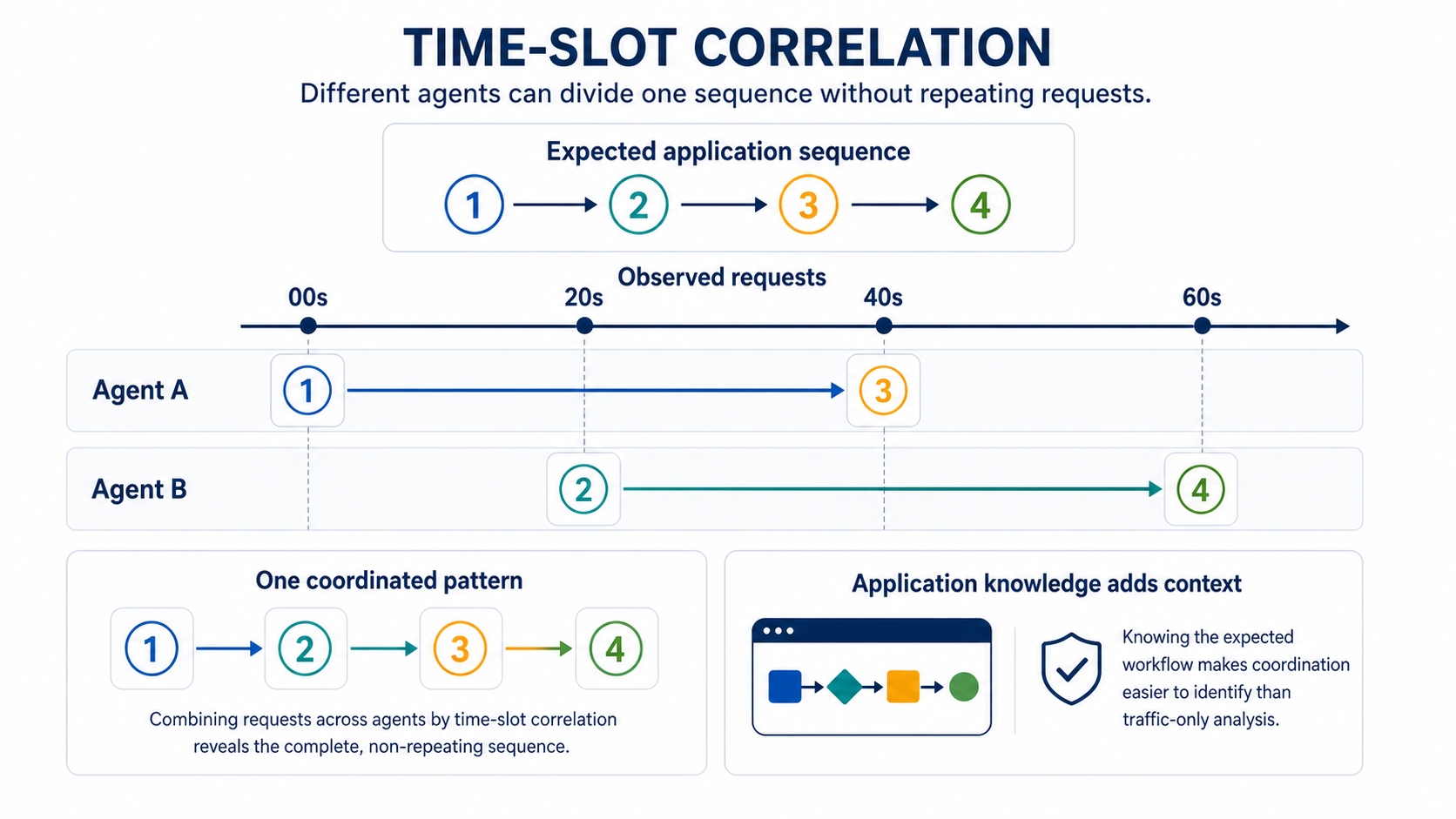
Application knowledge makes this correlation substantially stronger. Suppose a legitimate client would normally request objects 1, 2, 3, and 4 in sequence. If A requests 1 and 3 while B requests 2 and 4 in the intervening time slots, neither identity repeats the other’s work and each remains low-volume. Together, however, they reconstruct the complete ordered workflow.
A traffic-only detector can observe timing, routes, and technical similarities. An application-aware detector also knows which resources belong to the same workflow, which order is expected, which session should own the sequence, and which transitions are legitimate. That internal context makes coordinated misuse easier to distinguish from unrelated requests.
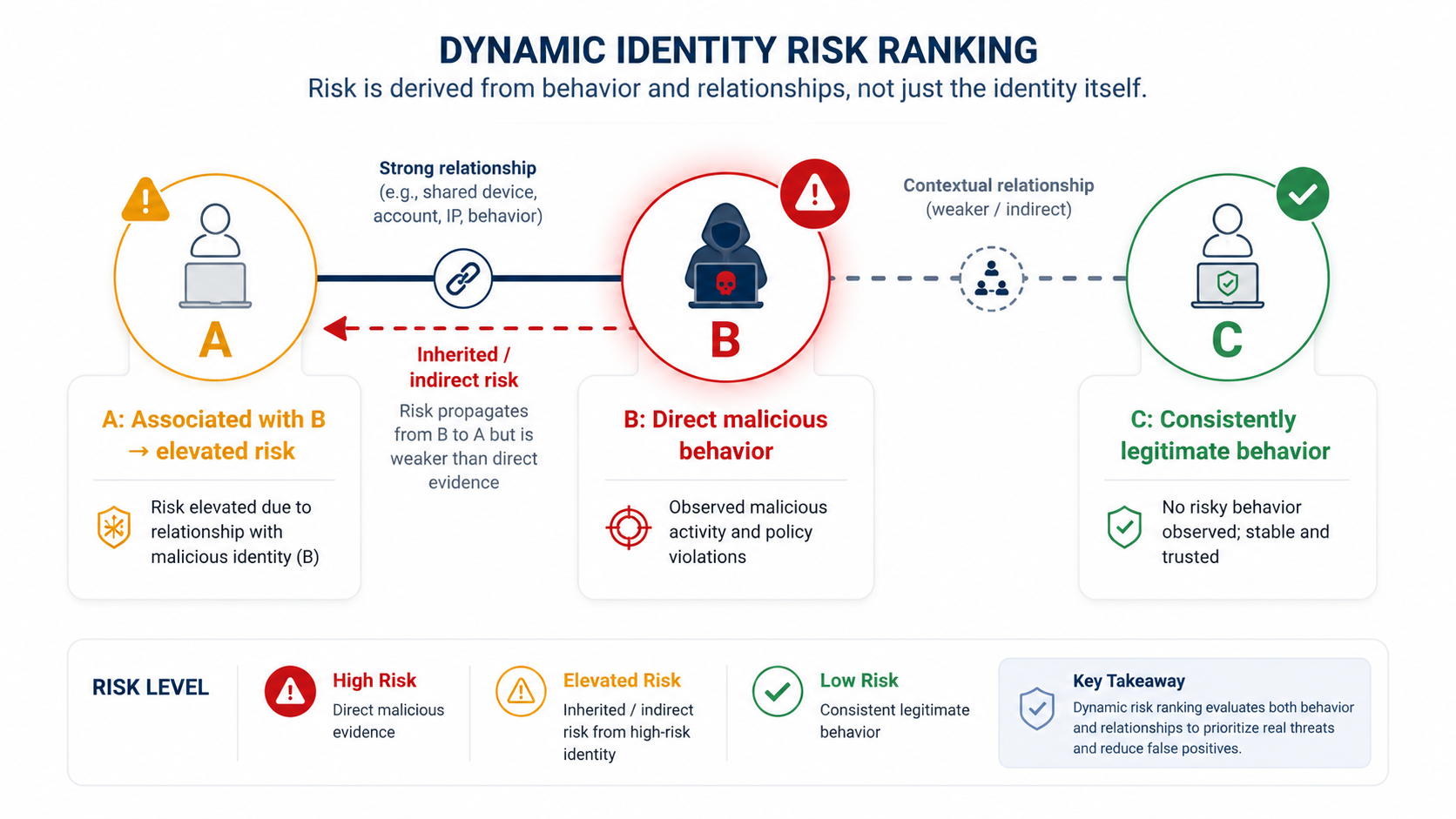
A useful mental model is a social graph. If A repeatedly appears close to B whenever B performs confirmed malicious activity, the relationship increases A’s risk. If A later maintains the same relationship with C, and C also produces direct malicious evidence, the three may form a cluster—a digital “gang” of coordinated identities.
The analogy is memorable, but the implementation must be more disciplined than “a friend of a bad actor is bad.” The system asks how often the identities appear together, how close the events are, whether they divide one task, whether the technical evidence agrees, how likely the relationship is to occur legitimately, and whether the pattern repeats.
Controlled Risk Propagation, Not Guilt by Association
An association is evidence, not proof. Risk may propagate through a relationship graph, but it must be limited by relationship strength, confidence, distance, time, direct evidence, and the probability of legitimate coincidence.
A single shared address on a mobile carrier should carry little weight. A repeated relationship involving timing, route coordination, device characteristics, fingerprint similarity, shared tokens, and consistent recurrence can carry substantially more. Direct evidence must remain distinguishable from inherited or relational evidence so an analyst can understand why the score changed.
Controls should also limit how far risk travels. If A is strongly related to B and B is weakly related to C, the system should not automatically treat every identity near C as malicious. Unbounded propagation converts a useful graph into a false-positive amplifier.
A production model therefore needs:
- Confidence values for both signals and relationships.
- Different weights for direct and indirect evidence.
- Caps on inherited risk and graph distance.
- Temporal decay and signal expiration.
- Allowlisted or understood infrastructure contexts.
- Explanations that identify the events responsible for each change.
- Human review for high-impact or ambiguous decisions.
Risk Must Be Able to Decrease
A dynamic ranking that only increases eventually classifies normal traffic as hostile. Legitimate users share networks with attackers, use VPNs, block scripts, change devices, travel, and sometimes behave unusually. Old evidence also loses relevance as addresses are reassigned, devices are cleaned, and campaigns end.
Suppose A was initially associated with B and C. A’s rank increased because the group repeatedly appeared around reconnaissance activity. Later, however, A follows normal navigation paths, spends realistic time reading, produces consistent interaction, completes an established business workflow, uses a stable account, and stops overlapping the malicious sequence. That evidence should reduce both the score and the confidence that A belongs to the cluster.
Useful reduction mechanisms include temporal decay, expiration by signal type, rehabilitation through legitimate behavior, reduced weight for weak relationships, separation from the cluster, and reversal when better identity resolution shows that the association was coincidental.
Verified legitimate behavior should reduce uncertainty gradually, but it should not immediately erase high-confidence direct evidence. An attacker may deliberately perform normal-looking activity to lower its ranking and launder its reputation before resuming abuse. Evidence-specific score floors, minimum retention periods, capped recovery rates, and slower decay for confirmed malicious events help prevent that strategy while still allowing genuine rehabilitation.
The result is an accumulated but reversible ranking. It can prioritize an identity before direct behavior crosses a traditional threshold without permanently punishing the identity for one old or ambiguous relationship.
Global Intelligence and Local Relevance
Large security and cloud providers observe traffic at a scale no individual organization can reproduce. Their intelligence can identify known malicious networks, botnets, exploit campaigns, scanners, command-and-control infrastructure, and reputation that existed before the first local request.
That breadth is valuable, but local context answers a different question: does this identity matter to our systems, applications, users, and workflows? An address known to be malicious elsewhere becomes operationally important when it reaches the protected environment, targets a relevant route, or forms a relationship with an identity already observed locally.
Once A is conclusively known to be malicious, repeatedly proving that A is malicious adds diminishing value. The priority moves to enforcement and discovery:
- Block, isolate, challenge, or observe A according to policy.
- Find the identities, infrastructure, accounts, and targets related to A.
- Determine whether the campaign has already succeeded elsewhere in the workflow.
- Protect the local business process rather than merely expanding a global list.
The strongest design combines external breadth with local depth. External intelligence supplies prior reputation; local behavior establishes relevance; relationship analysis finds identities that public lists may not yet recognize; business context determines the response.
LLM-Assisted Analysis Under Deterministic Authority
Large language models can add an interpretation layer when the underlying evidence is structured, bounded, and auditable. They can summarize event sequences, compare a current cluster with previous incidents, explain why a score moved, identify less obvious relationships, and help an analyst navigate large volumes of heterogeneous telemetry.
An LLM might receive authentication events, route probes, timing distributions, honeypot access, fingerprint comparisons, historical reputation, graph relationships, rule results, and legitimate-behavior evidence. It could produce an explanation such as:
Identity A presents elevated risk because it repeatedly alternates requests with two identities that accessed administrative honeypots during the same hourly window. Its recent authenticated workflow and interaction pattern differ from the cluster, reducing confidence that it belongs to the same operation.
That explanation is not proof and should not become an autonomous blocking command. LLMs can produce convincing interpretations unsupported by evidence, react inconsistently to incomplete context, and make some conclusions difficult to reproduce. Sensitive actions must remain grounded in explicit thresholds, deterministic controls, historical records, documented evidence, and accountable policy.
The LLM may correlate, summarize, explain, and prioritize. The security engine retains final authority.
A Layered Reference Architecture
No single layer sees the complete operation. The edge sees network and protocol activity. The web server sees requests. The browser telemetry sees interaction. The application understands the expected workflow. The identity service knows accounts and authentication. The risk engine connects events over time.
Edge / WAF / rate limits
        ↓
HTTP, TLS, IP, and reputation evidence
        ↓
Session, browser, device, and interaction evidence
        ↓
Application workflow, account, and business rules
        ↓
Identity resolution + event history
        ↓
Temporal clustering + relationship graph
        ↓
Dynamic risk ranking + deterministic decisions
        ↓
LLM-assisted explanation and analyst review
Honeypots, external intelligence, IDS/IPS, EDR, cloud telemetry, and database activity can contribute additional evidence at the appropriate layer. The architecture succeeds because the layers reinforce one another, not because any one detector is perfect.
Signals Below the Application Layer
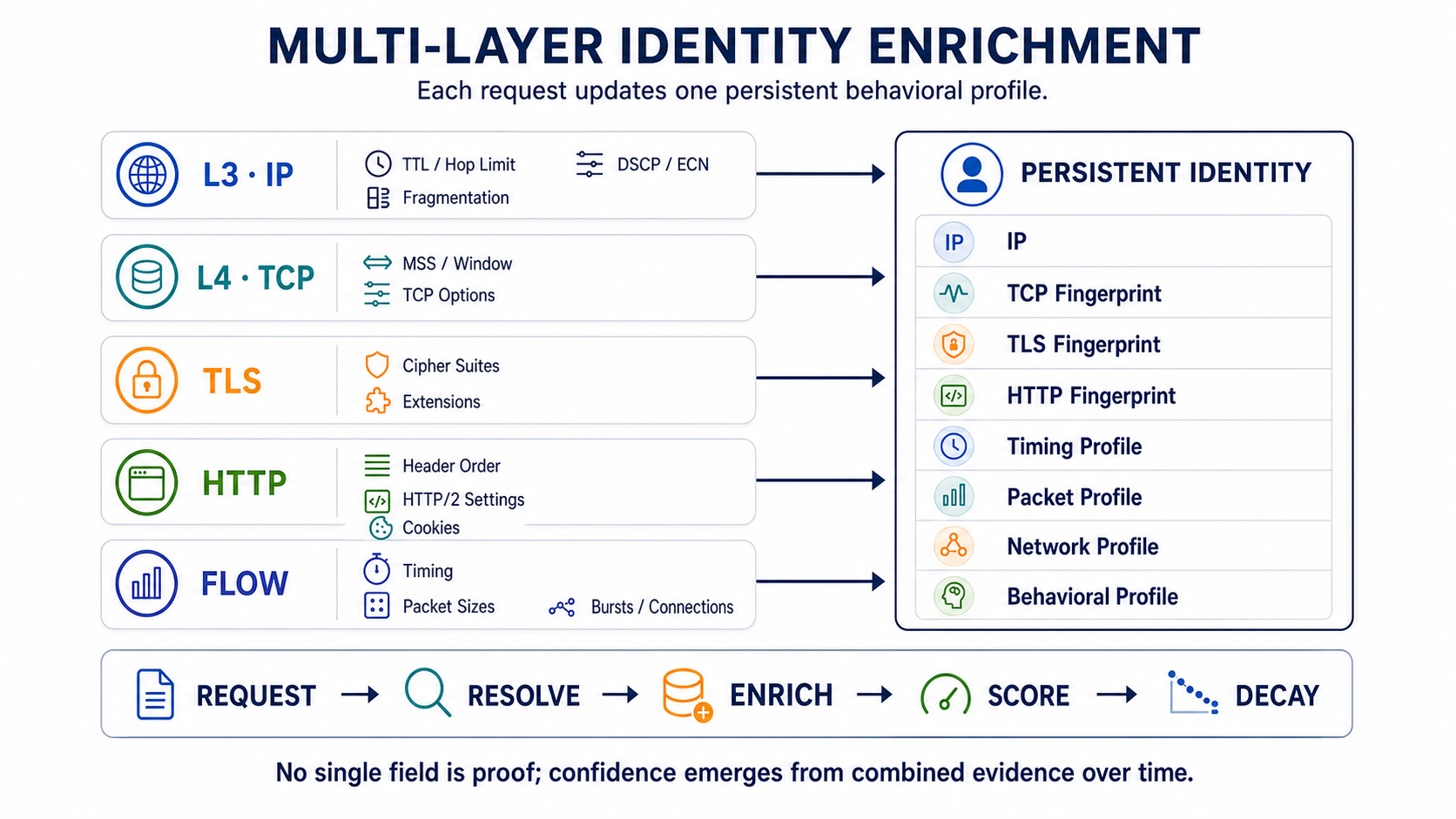
Traditional web security focuses primarily on the HTTP request: IP address, headers, cookies, session state, request rate, and application behavior. Those signals remain valuable, but they represent only part of the communication stack. A richer identity emerges when observations from IP, TCP, TLS, HTTP, flow behavior, and the application’s own workflow are combined.
The engineering value is not in making application code parse every bit of every packet. It is in extracting fingerprints and behaviors that normally never reach the application, normalizing them into evidence, and attaching that evidence to a persistent identity. Each layer contributes context; no individual field establishes an actor with certainty.
IP Layer (Layer 3)
The IP header can contribute network-stack and path observations such as:
- TTL or Hop Limit. The observed value combines the sender’s initial setting with the path already traveled.
- DSCP and ECN. Quality-of-service and congestion-notification behavior may expose network policy or unusual client behavior.
- DF/MF flags, fragment offsets, and fragmentation frequency. These describe how packets are permitted or required to fragment.
- IP Identification. Generation behavior may contribute a weak stack or device signal.
- IP options. They are rare in modern web traffic and therefore potentially distinctive when present.
- Packet length and size distribution. These become more informative when evaluated across a flow rather than as isolated values.
These attributes can support inferences about operating-system families, intermediate devices, NAT or proxy behavior, and anomalous network activity. They are not direct declarations of an operating system. Paths, tunnels, carriers, firewalls, and other middleboxes can modify or normalize them.
TCP Layer (Layer 4)
The initial handshake—particularly the SYN packet—usually provides richer stack information:
- Maximum Segment Size (MSS).
- Window size and window scale.
- SACK support.
- TCP timestamps and ECN support.
- TCP option values and option ordering.
- Retransmission behavior and initial round-trip time.
- ACK timing and acknowledgement patterns.
Together, these observations form a TCP/IP stack fingerprint. Two clients can report the same User-Agent while presenting materially different TCP fingerprints, indicating different software stacks, devices, proxy paths, or networking environments. The reverse is also possible: many clients can share a fingerprint because they use the same stack or traverse infrastructure that normalizes it. The fingerprint is evidence, not identity by itself.
TLS Handshake
Before encrypted application data is exchanged, the TLS ClientHello may expose:
- Cipher suites and their ordering.
- TLS extensions and extension ordering.
- Supported groups and signature algorithms.
- Application-Layer Protocol Negotiation (ALPN).
- Server Name Indication when visible.
- Session resumption behavior.
- GREASE values and placement.
These fields can produce fingerprints such as JA3 or JA4. They are generally more difficult to manipulate consistently than a User-Agent because a client must reproduce a broader handshake implementation, but they can still be imitated. Visibility also depends on the collection point, TLS version, proxy architecture, and features such as Encrypted Client Hello.
HTTP Layer
Once TLS is terminated at an authorized point, HTTP contributes another family of characteristics:
- Header ordering, missing headers, and capitalization.
- Cookie creation, continuity, and presentation.
Accept-LanguageandAccept-Encoding.- HTTP/2 SETTINGS values and ordering.
- Pseudo-header ordering.
- Connection reuse and request multiplexing.
Many automation frameworks generate consistent HTTP patterns that differ from current browsers. Reverse proxies can reorder, remove, add, or normalize headers, so the detector must know whether it is observing the original client request or a transformed request at the origin.
Flow Behavior
The most durable information may not come from any individual field. It may come from the communication pattern itself:
- Time between packets and requests.
- Packet-size distribution and burst behavior.
- Retries and retransmission frequency.
- Connection persistence, parallelism, and Keep-Alive use.
- Latency characteristics and temporal activity distribution.
These patterns can remain stable even when an operator rotates addresses, changes User-Agent strings, or moves through different proxy infrastructure. They must still tolerate ordinary network variation, congestion, mobile handoffs, caching, and changes introduced by the observation point.
Building a Persistent Identity
Instead of evaluating each packet or request independently, the system continuously enriches a persistent identity profile:
identity
{
    ip
    tcp_fingerprint
    tls_fingerprint
    http_fingerprint
    timing_profile
    packet_profile
    network_profile
    behavioral_profile
}
Each request updates that profile rather than triggering an isolated conclusion:
request
  → resolve the most likely identity
  → merge available network, protocol, browser, and application evidence
  → update confidence, relationships, and risk
  → expire or decay stale signals
Not every request supplies every field. Missing telemetry should remain unknown rather than being interpreted as malicious. Each stored observation should retain provenance, collection time, confidence, useful lifetime, and the transformation path that produced it. The strength of the approach lies in combining many small observations into a coherent behavioral identity that becomes increasingly difficult to evade without requiring any single attribute to serve as proof.
Respond Proportionally to Confidence and Impact
The appropriate outcome is not always a permanent block. The same risk ranking can support graduated responses:
- Allow and record. Preserve low-risk evidence without adding friction.
- Observe more closely. Increase telemetry or shorten evaluation intervals when uncertainty rises.
- Rate-limit or degrade. Reduce operational impact while continuing to collect evidence.
- Challenge. Require stronger browser proof, authentication, or step-up verification.
- Isolate. Restrict the identity to a controlled path or remove access to sensitive operations.
- Block and alert. Apply a temporary or durable restriction when evidence and business impact justify it.
A high-confidence honeypot exploit may justify immediate action. A weak relationship through shared infrastructure may justify only observation. The potential harm of the response should influence the evidence threshold: preventing access to a public brochure is not equivalent to stopping a healthcare transaction or freezing a customer account.
Privacy, Calibration, and Operating Boundaries
Fingerprinting and relationship analysis require explicit governance. Organizations should collect only signals that serve a defined security purpose, protect the resulting telemetry, establish retention and expiration, restrict access, document automated decisions, and consider consent and applicable law.
The model must be calibrated in its own operating environment. False positives should be measured, reviewed, and used to adjust baselines. Legitimate automation should be identified when possible. Security teams should distinguish what was directly observed from what was inferred and retain enough evidence to reproduce material decisions.
The techniques in this article are not a replacement for secure software, patching, strong authentication, least privilege, protected origins, segmentation, monitoring, or incident response. They add a correlation and prioritization layer that helps those controls recognize distributed behavior.
Final Principle
A modern bot cannot be identified reliably because it made many requests or reported a suspicious user_agent. The meaningful pattern emerges from technical identity, behavior, history, timing, relationships, and the protected application’s own business context.
An identity may look harmless in isolation and still participate in a coordinated operation. Another may look suspicious because of a shared network and later prove legitimate. Dynamic ranking must therefore accumulate evidence, propagate risk carefully, explain its reasoning, decay over time, and allow rehabilitation.
Do not ask only whether A is a bot. Ask what A is doing, who repeatedly acts around A, whether the combined pattern changes the risk, and which response the evidence can responsibly support.
Further Reading
These external references provide a vendor-neutral threat vocabulary, implementation documentation from two major bot-management platforms, and an academic treatment of graph-based detection.
- OWASP Automated Threats to Web ApplicationsA vendor-neutral ontology covering automated misuse such as credential stuffing, scraping, fingerprinting, scalping, and vulnerability scanning.
- Cloudflare Bot Solutions DocumentationProduct documentation for bot scoring, JavaScript detections, sequence rules, analytics, false-positive handling, and graduated response options.
- AWS WAF Bot ControlDocumentation for managed bot categories, targeted inspection, browser interrogation, fingerprinting, behavioral heuristics, labels, and custom enforcement.
- Botnet Detection Using Graph-Based Feature ClusteringJournal of Big Data, 2017. A graph-topology approach using degree, clustering coefficient, betweenness, eigenvector centrality, and node clustering. DOI: 10.1186/s40537-017-0074-7.