The software company conducts a formal requirements-gathering process, estimates the project at $100,000, and requests 40% upfront. Over the next two months, consultants interview employees, prepare process diagrams, and produce detailed requirements documents.
Every requirement has its own page. Each page includes a description, assumptions, acceptance criteria, and an executive signature.
The process appears organized, professional, and controlled. Executives believe they can already visualize the future system through the documentation.
Development begins.
Several months later, the software company requests an additional 25% payment. The client has now paid most of the project cost but still has no usable software. There is nothing operational to test because the agreement established that the complete solution would be presented near the end of the project.
The client becomes concerned but continues waiting. The requirements were approved, the schedule was accepted, and every document was signed.
Eventually, the software company presents the solution.
There are bugs, which are expected and can usually be corrected. The more serious problem is that several important requirements are wrong, incomplete, or based on inaccurate assumptions.
Some workflows were oversimplified. Operational exceptions were not documented. Different departments interpreted the same terminology differently. Users approved written descriptions without understanding how those descriptions would behave when converted into software.
Major portions of the solution must now be redesigned.
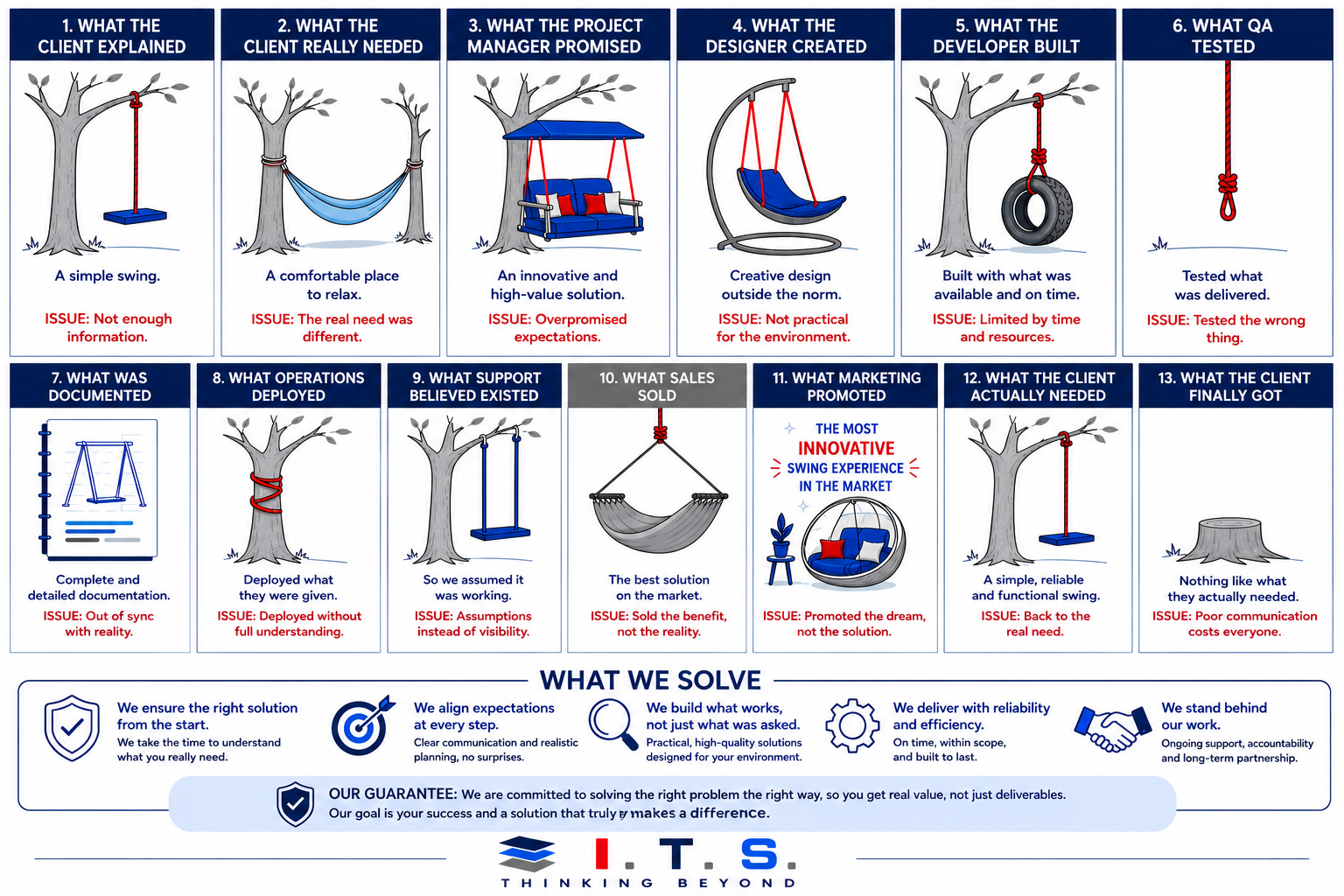
What the Sign-Off Actually Accomplished
The signed requirements created the appearance of certainty, but they did not prove that the software would work.
An executive signature confirmed that a document had been reviewed. It did not confirm that:
- The requirement represented the actual operational workflow.
- Every relevant exception had been identified.
- Users understood how the written requirement would behave in software.
- The proposed design was usable.
- The requirement was technically complete.
- Different departments interpreted the terminology consistently.
- Security, auditing, recovery, and operational controls had been addressed.
- The system would support real data and real operating conditions.
- The implemented solution would produce the expected business result.
The sign-off process did not eliminate risk. In many cases, it merely transferred risk from the software company to the client.
When the client later identifies a missing workflow, the vendor can point to the approved document:
“That was not included in the signed requirements.”
The signature becomes a contractual defense rather than evidence that the solution was correctly understood.
Documentation Is Not Validation
A requirement can be perfectly documented and still be wrong.
Users frequently approve requirements because the language appears reasonable. However, reading a description is fundamentally different from interacting with a working process.
Consider the following requirement:
“The user may adjust the claim and submit it for approval.”
The sentence appears clear, but it leaves many operational questions unanswered:
- Which fields may be adjusted?
- Who is authorized to make the adjustment?
- What happens to the original values?
- Is the adjustment audited?
- Can the claim be modified after approval?
- Who receives the approval request?
- What happens if the approver rejects it?
- Do different adjustments require different approval levels?
- Can an approval be canceled or reversed?
- How does the adjustment affect payments, accounting, reporting, and downstream processes?
A signed paragraph does not answer these questions unless the complete operational behavior has been explored and validated.
A document captures an interpretation of a requirement. Working software reveals its consequences.
Explicit and Implicit Requirements
One of the greatest weaknesses of the sign-off culture is its treatment of implicit requirements.
Not every requirement is stated directly. Many requirements are inherent in the objective, the operating environment, or the reasonable expectations of the people who will use the system.
President John F. Kennedy described the objective of the Apollo program in remarkably simple terms: land a man on the Moon and return him safely to Earth.
The objective was clear, but it was not a complete engineering specification.
It did not explicitly describe every requirement related to propulsion, navigation, communications, life support, structural integrity, temperature control, radiation exposure, redundancy, emergency procedures, lunar landing, reentry, recovery, or astronaut safety.
No reasonable engineer would have argued that life support was outside the project scope because it was not separately listed in the original objective.
Returning the astronauts safely made life support, navigation, communication, reentry, and recovery implicit requirements.
Software projects contain the same type of implicit requirements, although they are less dramatic and easier to overlook.
A client may say:
“I only need a system to store these forms.”
The explicit requirement appears simple: store the forms.
However, that statement immediately creates additional questions:
- How does a user enter a form?
- Which fields are required?
- How are values validated?
- How does the user find a previously entered form?
- Can forms be searched, filtered, and sorted?
- Who is permitted to view them?
- Who may create, modify, approve, or delete them?
- What happens when a user enters incorrect information?
- Can a submitted form be corrected?
- Are previous values preserved?
- Can a deleted form be recovered?
- Is every change recorded in an audit trail?
- Do logs show who performed each action and when?
- Can users attach documents?
- How long must records be retained?
- Are sensitive fields encrypted?
- Are backups available?
- How is information restored after a failure?
- What happens when two users modify the same form?
- How are errors reported?
- Can the information be exported?
- Are reports required?
- What happens when the number of forms grows from hundreds to millions?
The client may not explicitly mention security, auditing, access control, logs, backups, recovery, search, history, concurrency, validation, or error handling.
That does not necessarily mean those capabilities are optional or outside the intended scope.
A system that stores forms but does not allow users to find, review, correct, protect, audit, or recover them may technically satisfy one sentence while failing its actual purpose.
Implicit Requirements Are Not Automatically Scope Creep
The distinction between an implicit requirement and a new request is essential.
A client asking for an unrelated inventory module after development begins may be expanding the scope.
A client asking how to retrieve a form from a system designed to store forms is not necessarily expanding the scope. Retrieval may be inherent in the original business objective.
Similarly, access control, data integrity, auditability, backup, recovery, and basic error handling are often foundational characteristics of an operational system. They should not appear as expensive surprises after implementation.
This does not mean that every possible feature must automatically be included.
It means the software company must identify the operational implications of the stated objective and convert them into explicit decisions.
The vendor should ask:
“When you say the system must store forms, what must users be able to do with those forms after they are stored?”
The answers should then be demonstrated and validated through working software rather than assumed from a signed paragraph.
The Vendor’s Responsibility Is Discovery, Not Transcription
A software company is not hired merely to type the client’s statements into a requirements document.
Clients understand their operations, but they may not know how to describe every technical dependency, quality attribute, security control, failure scenario, or data-management requirement necessary to build a complete system.
The vendor is expected to contribute technical and analytical expertise.
That responsibility includes identifying:
- Missing workflows.
- Implicit functionality.
- Security requirements.
- Audit and compliance needs.
- Data-retention rules.
- Error and recovery scenarios.
- Integration dependencies.
- Operational exceptions.
- Performance expectations.
- Concurrency issues.
- Reporting requirements.
- Assumptions that require validation.
A consultant who documents only the client’s exact words is acting as a transcription service, not as a systems analyst.
The purpose of requirements discovery is not merely to record what was said. It is to uncover what must be true for the proposed solution to work.
Signatures Cannot Resolve Unasked Questions
An executive may sign a requirement stating:
“The system shall store electronic forms.”
That signature does not establish whether forms may be modified, deleted, restored, searched, exported, versioned, secured, or audited.
Those questions remain unresolved even though the requirement has been approved.
The danger appears later, when the vendor says:
“Search was not included.”
“Audit history was not specified.”
“Recovering deleted forms is a new requirement.”
“Role-based access was not part of the signed scope.”
At that point, the project has entered a contractual argument about functionality that should have been explored during discovery, implementation, and incremental validation.
The signature proves that a sentence was approved. It does not prove that the operational implications of that sentence were understood.
Software Is a Living Product
Software should not be treated as a static object that can be completely defined once, constructed according to a fixed document, and considered permanently finished at delivery.
Software is a living product.
It grows, evolves, and changes with the organization that uses it.
Requirements are not simply collected before development begins. They are progressively refined during analysis, design, construction, testing, deployment, and validation.
Some requirements become clearer only after developers begin implementing them. Others change when users interact with working software and recognize that the documented behavior does not adequately support the real operation.
During development, the project team may discover:
- Hidden dependencies between workflows.
- Operational exceptions that were not identified during interviews.
- Security or audit requirements implied by the process.
- Technical limitations that require a different design.
- Inconsistent terminology between departments.
- Data conditions that contradict the original assumptions.
- Integration behaviors that were not previously visible.
- Better and simpler ways to achieve the intended result.
During validation, users may discover that a requirement was technically implemented exactly as written but does not behave as they expected.
This is not necessarily evidence that the project was poorly managed.
It is often a normal part of converting an abstract business need into an operational system.
A user may approve a document stating that a claim can be adjusted. Only after interacting with the system may the user recognize that different adjustments need different authorization levels, that original values must remain visible, or that some changes must reverse downstream transactions.
The written requirement did not necessarily change because the client became indecisive. It changed because the organization’s understanding became more complete.
Requirements Are Refined During Construction
Requirements should not be viewed as raw material handed to developers before construction begins.
They are refined during construction.
When developers create database structures, interfaces, workflows, integrations, and security rules, abstract statements must be converted into precise operational behavior.
That conversion exposes questions that may not have been visible during interviews.
A requirement such as:
“Managers may approve requests.”
must eventually become a series of technical and operational decisions:
- Which managers?
- Based on department, location, amount, or request type?
- Can approval authority be delegated?
- What happens during an absence?
- Is one approval sufficient?
- Can an approver modify the request?
- Can the approval be withdrawn?
- What happens after rejection?
- Is the decision permanent?
- How is the decision audited?
- Are notifications required?
- What happens if the organizational hierarchy changes?
The act of building the feature helps reveal the actual requirement.
For that reason, development is not merely the mechanical implementation of requirements. It is also part of the discovery process.
Requirements Change During Validation
Requirements may change again when the software is validated.
Validation places the proposed behavior in front of users with realistic data and scenarios. At that point, users are no longer imagining how the system might work. They are experiencing how it actually works.
They may discover that:
- A process requires too many steps.
- A field appears too late in the workflow.
- A required value is not available at the expected time.
- An approval rule does not match real authority.
- A report does not support the decision it was intended to support.
- An exception occurs more frequently than expected.
- A technically correct process is operationally impractical.
- Different departments need different views of the same information.
These discoveries should not automatically be treated as failures or unauthorized scope changes.
They should be evaluated according to their origin and impact.
Some may be genuine new requests. Others may be clarifications of the original objective. Still others may reveal that the documented requirement was incomplete or misunderstood.
The purpose of validation is to make these discoveries while change is still manageable.
Change Must Be Controlled, Not Denied
Treating software as a living product does not mean accepting unlimited scope, uncontrolled spending, or endless development.
Change must be managed.
Each proposed change should be evaluated for:
- Business value.
- Operational necessity.
- Technical impact.
- Cost.
- Schedule impact.
- Security consequences.
- Data consequences.
- Testing requirements.
- Dependencies.
- Priority.
The purpose of governance is not to pretend that requirements will never change.
The purpose of governance is to detect change early, understand it, prioritize it, and incorporate it responsibly.
The wrong question is:
“How can we prevent requirements from changing?”
The better questions are:
“How can we discover changes as early as possible?”
“Why did the requirement change?”
“Is this a new request, a clarification, or a previously unidentified dependency?”
“What is the impact of incorporating it now?”
“What is the cost of not incorporating it?”
A project that denies legitimate discovery may remain technically compliant with its original documents while moving steadily toward operational failure.
The System Continues Evolving After Delivery
Even after implementation, the software continues to evolve.
Business processes change. Regulations change. Users identify new efficiencies. Data volumes increase. Security threats change. Organizational structures are modified. New integrations become necessary. Reporting expectations expand. Operational priorities shift.
A system that cannot evolve eventually becomes an obstacle to the organization it was created to support.
The original requirements may accurately describe what the organization needed at the beginning of the project. They cannot permanently define what the organization will need in the future.
The objective should therefore be to create a maintainable product with a controlled evolution process.
That includes:
- A prioritized product backlog.
- Versioned releases.
- Automated and repeatable testing.
- Clear ownership.
- Technical documentation.
- Upgrade and migration procedures.
- Monitoring and logging.
- Security maintenance.
- Data-quality controls.
- A process for evaluating new requirements.
A fixed document may describe the system envisioned at the beginning of the project.
A living product reflects what the organization actually needs over time.
Why Clients Accept the Sign-Off Model
The sign-off model is attractive because it creates the appearance of predictability.
Executives receive:
- A fixed project cost.
- A defined schedule.
- A complete requirements package.
- Formal approval points.
- A promised delivery date.
This structure resembles construction or manufacturing, where a design can often be substantially finalized before production begins.
Software is different.
Users frequently cannot identify every requirement until they interact with the system. Developers discover hidden dependencies during implementation. Real data exposes scenarios that were not visible during interviews. Operational exceptions often become apparent only when a process is executed from beginning to end.
The original plan remains useful, but it cannot eliminate discovery.
The mistake is not documenting requirements.
The mistake is treating documentation as proof that discovery is complete.
The Financial Trap
The payment structure often intensifies the problem.
The client may pay:
- 40% to begin the project.
- 25% when development starts.
- Another percentage when the solution is presented.
- The remaining balance after final acceptance.
By the time the client sees working software, most of the budget may already be committed.
Changing direction then becomes difficult. The client is financially dependent on the vendor, while the vendor has little incentive to reconsider the original design without issuing change orders.
Every misunderstanding becomes an additional cost.
The client is told:
“The software matches the approved specification. The new request is outside the original scope.”
Contractually, the vendor may be correct.
Operationally, the project may still be failing.
A system can comply with every signed document and still fail to solve the organization’s actual problem.
Bugs Are Not the Main Risk
Clients often focus on bugs because bugs are visible.
However, bugs are usually easier to correct than incorrect requirements.
A bug means the software did not implement the intended behavior correctly.
A requirements failure means the intended behavior itself was wrong, incomplete, or misunderstood.
Correcting a bug may require modifying a function, condition, query, or calculation.
Correcting a requirements failure may require redesigning:
- Database structures.
- User interfaces.
- Security rules.
- Workflow states.
- Integrations.
- Reports.
- Approval processes.
- Audit logic.
- Data-conversion procedures.
- Downstream operations.
The later the failure is discovered, the more expensive it becomes.
A technically correct implementation of the wrong requirement is still the wrong solution.
A Better Alternative: Incremental Validation
Requirements should not be validated only through documents. They should be validated through working software.
Instead of spending months documenting the entire system before showing results, the project should deliver small, functional, and testable increments.
A practical cycle may look like this:
- Identify a core workflow.
- Document enough information to begin implementation.
- Build a functional prototype or initial version.
- Test it with super users and realistic data.
- Identify missing rules, dependencies, and exceptions.
- Refine the requirements and design.
- Obtain approval based on demonstrated behavior.
- Release the validated functionality or continue to the next workflow.
The process then repeats.
Each cycle improves both the software and the organization’s understanding of what the software must do.
This approach does not eliminate documentation, planning, contracts, or executive approval. It gives them a stronger foundation.
Executives are no longer approving only a written interpretation. The organization is approving observable system behavior.
Validate With Realistic Scenarios
Demonstrations should not be limited to ideal conditions.
A workflow that succeeds with one carefully prepared record has not necessarily been validated.
Testing should include:
- Incomplete data.
- Incorrect data.
- Duplicate records.
- Unauthorized users.
- Rejected approvals.
- Canceled transactions.
- Reopened cases.
- Concurrent modifications.
- Integration failures.
- Network interruptions.
- Large data volumes.
- Historical records.
- Unusual operational exceptions.
The objective is not to prove that the software works under perfect conditions.
The objective is to determine whether it supports real operations.
Every realistic scenario tested during development is one less surprise discovered after most of the budget has been spent.
Sign-Off Should Confirm Current Understanding
A sign-off should mean:
“Based on what we currently know and what has been demonstrated, this behavior is accepted.”
It should not mean:
“No additional operational requirement may ever be discovered.”
A sign-off should represent the best shared understanding at a particular point in time.
It should establish a controlled baseline, not permanently freeze the product.
When new information appears, the project team should determine whether it represents:
- A new business request.
- A clarification of an existing requirement.
- An implicit requirement that was not previously identified.
- An operational exception.
- A technical dependency.
- A correction to an incorrect assumption.
These categories may have different commercial consequences, but they all require evaluation.
The signature should support governance. It should not end discovery.
Earlier Results and Better Return on Investment
Incremental delivery allows the client to receive usable results before the entire solution is complete.
Instead of waiting months for a finished system, the client can begin using selected modules, workflows, reports, integrations, or automations as they are completed and validated.
These partial releases may immediately:
- Reduce manual work.
- Improve operational visibility.
- Eliminate repetitive errors.
- Accelerate existing processes.
- Improve data quality.
- Replace isolated spreadsheets.
- Reduce duplicate data entry.
- Provide information that was previously unavailable.
This produces a better return on investment because part of the project begins generating value while the remaining components are still under development.
It also reduces financial risk.
The client can evaluate the quality of the work, confirm that the project is moving in the correct direction, and determine whether the expected operational benefits are being achieved before committing the entire budget.
Under a traditional sign-off model, the client may spend most of the project budget before receiving anything usable.
Under an incremental model, each payment should correspond to visible progress, validated functionality, and measurable business value.
The client is not merely funding the promise of a future solution.
The client is progressively receiving the solution.
Payments Should Follow Demonstrated Value
Payment milestones should be connected to functional results rather than internal project activities.
Completing interviews, producing diagrams, or beginning development may represent effort, but they do not necessarily represent delivered value.
A stronger payment structure may associate payments with outcomes such as:
- A core workflow operating successfully.
- A module tested with realistic data.
- A validated integration.
- A completed migration stage.
- A usable report or automation.
- A production-ready release.
- A defined group of users performing real work.
This structure does not unfairly shift all risk to the vendor.
It aligns both parties around the same objective: delivering a working solution.
The client sees what it is paying for. The vendor receives payment for measurable progress.
Who Loses Under the Sign-Off Culture?
The sign-off culture is often presented as protection for the software company.
In reality, when the project fails, both parties lose.
The client may receive a system that does not support its operations despite having paid a substantial portion of the project cost.
The consequences may include delayed implementation, operational disruption, additional development costs, employee frustration, lost productivity, dependence on obsolete systems, and reduced confidence in future technology projects.
The software company also loses.
Even when the vendor can demonstrate that the delivered software matches the signed requirements, it may still face disputed invoices, support and remediation costs, reputational damage, lost referrals, loss of future work, employee burnout, arbitration, litigation, and the end of the business relationship.
The disagreement may eventually reach arbitration or court.
The client may argue that the vendor failed to deliver a usable solution. The vendor may argue that it implemented exactly what the client approved.
Either party may prevail legally.
However, by the time the dispute reaches that stage, both parties have already lost.
The client has invested money and time without receiving the expected value. The software company has invested resources in a project that did not produce a satisfied customer, a successful reference, or continuing business.
A legal victory does not transform a failed implementation into a successful project.
Who Wins When the Project Works?
When the solution works, both parties win.
The client receives a system that improves operations, reduces costs, increases visibility, strengthens controls, supports growth, reduces errors, and produces a measurable return on investment.
The software company receives more than the final payment.
It earns trust, credibility, referrals, support revenue, enhancement projects, additional integrations, new modules, and a long-term commercial relationship.
A successful implementation often becomes the beginning of continued business.
The client becomes a reference instead of a legal opponent.
The software company becomes a trusted technology partner instead of a vendor defending a contract.
The business relationship continues because the solution—not merely the documentation—succeeded.
This is why the objective of a software project should never be merely to satisfy a signed specification.
The objective should be to create and continuously improve a product that succeeds operationally.
The Real Measure of Progress
Documents, meetings, diagrams, and signatures are project artifacts.
They may be necessary, but they are not the product.
The product is working software.
A client who has paid 65% of a project should have more than a collection of approved documents. The client should have functional components, validated workflows, tested assumptions, and visible evidence that the solution is moving in the correct direction.
Progress should be measured by questions such as:
- What can users perform today that they could not perform before?
- Which workflows have been tested with realistic data?
- Which assumptions have been confirmed or rejected?
- Which implicit requirements have been identified?
- Which operational exceptions have been tested?
- Which risks have been reduced?
- What measurable value has already been delivered?
- What has been learned?
- What remains uncertain?
- How has the product improved during the latest iteration?
A project should not appear successful merely because every document has been signed.
Conclusion
The purpose of requirements gathering is not to create a contractual shield.
It is to build a shared understanding of the problem and progressively convert that understanding into a successful product.
Documentation is necessary. Signatures may be necessary. Contracts are necessary.
None of them can replace validation.
Requirements are not limited to the exact words written in a document. Some are explicit. Others are implied by the system’s purpose, operating environment, users, and the basic conditions necessary for the solution to function safely and effectively.
The objective of sending a person to the Moon and returning that person safely to Earth contained an enormous number of unstated engineering requirements.
A request to store electronic forms contains fewer requirements, but the principle is the same.
The system must do more than preserve data. Users must be able to find it, understand it, correct it, protect it, audit it, recover it, and use it within the organization’s actual operations.
Those requirements will not always be completely understood at the beginning.
They will be refined during construction. They may change during testing and validation. They will continue evolving after deployment as the organization, its risks, and its objectives change.
That does not make the project uncontrolled.
It makes the project honest about the nature of software.
A competent requirements process brings explicit and implicit expectations into the open. A competent delivery process validates them through working software. A competent governance process manages change without denying that discovery will continue.
When approval becomes more important than demonstrated behavior, the client and the software company begin protecting themselves from each other instead of working toward the same result.
If the project fails, both sides lose—even when one party later wins the legal argument.
If the project succeeds, both sides benefit. The client receives operational value and a return on its investment. The software company earns trust, reputation, continued business, and a long-term relationship.
The goal should not be to determine who is responsible after the project fails.
The goal should be to create a process in which both parties succeed.
A culture of sign-off asks:
“Who approved this requirement?”
A culture of validation asks:
“Does the system actually work?”
A product culture asks:
“What have we learned, and how should the software evolve?”
The first question protects a position in a dispute.
The second protects the project.
The third protects the future of the product and the relationship between the client and the software company.
A culture of sign-off protects the contract.
A culture of validation protects the project.
A culture of continuous evolution protects the product.